Technology Strategy Framework
A Business-First Approach to Technology Leadership
Technology strategy should not begin with technology. It should begin with the organization's goals, its operational challenges, and the outcomes it seeks to achieve.
My approach to technology leadership is founded on a simple principle: technology exists to enable business performance. Every investment, initiative, and decision should contribute to growth, operational excellence, risk reduction, resilience, efficiency, or competitive advantage.
Over the course of my career, I have developed and refined a framework that helps assess technology organizations, identify opportunities for improvement, and create sustainable strategies that deliver measurable value.
What Great Looks Like
Clear alignment with business strategy
Strong leadership & accountability
Reliable & resilient operations
Scalable platforms & architecture
Trusted data & actionable insights
Disciplined governance & risk management
A culture of continuous improvement & innovation
Commercialize Technical Capabilities
Translate engineering, data, SCADA/cyber, and digital expertise into scalable, client-facing offerings, including analytics-driven services, digital products, and platform-enabling delivery models.
Package core capabilities into repeatable offerings that can be deployed consistently across clients and portfolios
Partner with commercial teams to align solution development with market demand and client needs
Lead Post-Acquisition Integration & Platform Strategy
Standardize platforms, data models, and governance across acquired assets and portfolios to enable consistent execution and portfolio-wide visibility.
Define integration frameworks and playbooks to accelerate onboarding of new assets and capabilities
Rationalize tools and systems to reduce complexity while maintaining flexibility across diverse portfolios
Accelerate Digital & Data Transformation
Build integrated data platforms and expand use of cloud, AI, advanced analytics, and automation to enhance asset performance, enable predictive insights, and support portfolio-level optimization.
Develop integrated data platforms that connect asset performance, operational, and financial datasets
Expand advanced analytics and automation capabilities to support proactive decision-making and operational efficiency
Align Technology with Business Strategy
Establish the Technology Business Area as a core driver of revenue growth scalability, aligning initiatives to measurable business outcomes and positioning technology as a strategic partner, instead of a function.
Define and govern a technology roadmap directly linked to business priorities, client outcomes, and commercial objectives
Establish performance metrics and investment frameworks that ensure accountability for value delivery
Strengthen Cybersecurity & Operational Resilience
Embed cyber and OT security capabilities into all solutions and client offerings to ensure secure, compliant, and resilient operations.
Integrate cybersecurity into all stages of solution design, delivery, and operations across IT and OT environments
Strengthen governance and risk management practices to protect critical infrastructure and support regulatory compliance
Enable an Integrated Operating Model
Align engineering, SCADA/cyber, and data teams around shared objectives and delivery models to improve execution and deliver cohesive, scalable solutions.
Define clear roles, interfaces, and delivery models across practice areas to support integrated client outcomes
Establish governance and collaboration frameworks that enable knowledge sharing and consistent execution
Develop Technology Leadership & Capability
Build leadership depth through targeted development, capability building, and succession planning to support sustainable growth, innovation, and organizational resilience.
Invest in leadership development and mentoring to strengthen decision-making, accountability, and cross-functional collaboration
Build critical capabilities in digital, data, and cyber domains to support long-term strategic priorities
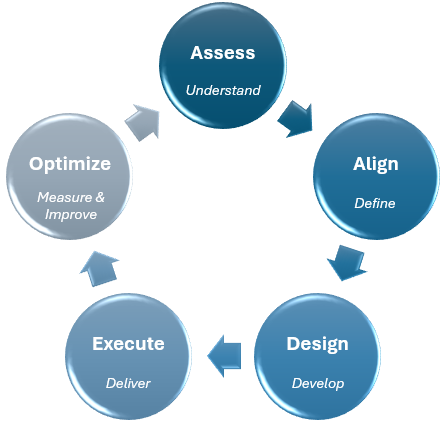
Technology Transformation Lifecycle
Executive Decision-Making Principles
Value Over Activity
Focus on measurable outcomes rather than the volume of work performed.
Simplicity Over Complexity
Reduce unnecessary complexity to improve agility, reliability, and scalability.
Long-Term Sustainability
Prioritize solutions that support future growth and organizational resilience.
Data-Informed Decisions
Use objective metrics and business insights to guide prioritization and investment decisions.
People-Centered Transformation
Recognize that successful technology change requires adoption, engagement, and leadership at every level.